The 2020 pandemic brought continuous enrollment to Medicaid, meaning that people could enroll at any time. Individuals who were not previously on Medicaid now had easier access to it. Even in 2026, six years post-pandemic, there are 8% more individuals enrolled in Medicaid than there were in February of 2020.
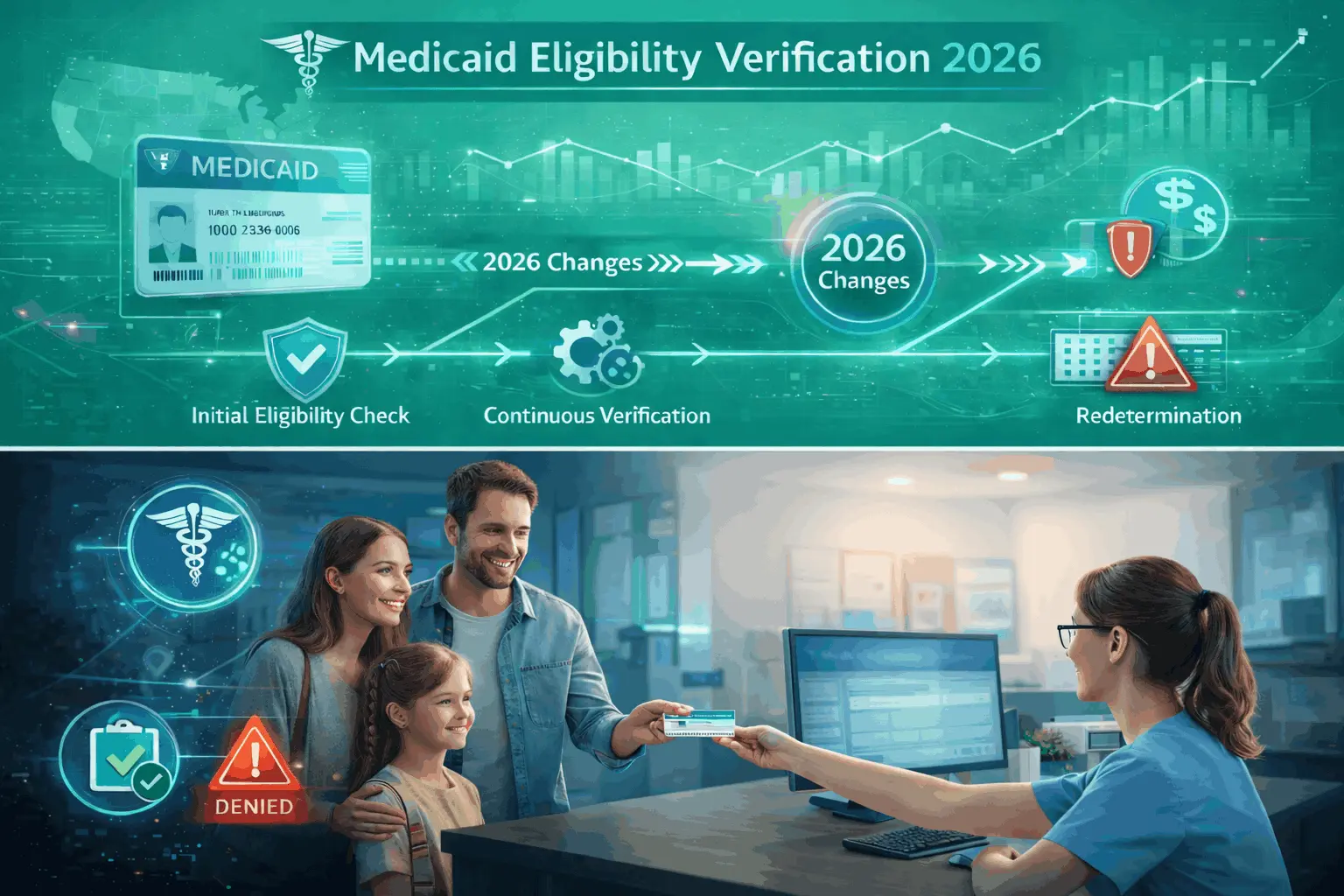
However, this year marks a major change for Medicaid eligibility verification because states are finishing up applying "unwinding." This is the process of "ending coverage for people found ineligible or whose redetermination can't be completed for procedural reasons."
Additionally, policy changes from recent years, including the passing of H.R.1, have to lead to stricter requirements to check Medicaid eligibility throughout the year. In this article, we'll discuss these legal changes in detail so that your hospital, government agency, or nonprofit organization can choose the right software to remain compliant for Medicaid eligibility in 2026.
What Is Medicaid Eligibility and Why Does It Change by State?
Medicaid eligibility consists of the rules that determine if someone can enroll in Medicaid. It can become complicated because Medicaid is funded by both the federal government and individual states. Each state manages its own program, so the rules differ for each.
For the purpose of this article, we will look at the different Medicaid eligibility requirements for the state of Kentucky. To be eligible, individuals must fall into one of the following categories:
- Children
- Low-income adults
- Parent and caretaker relatives
- Pregnant and postpartum women
- The elderly (age 65 or above)
- People with disabilities
Additionally, adults 19-64 can only have countable income up to 138% of the Federal Poverty Level (FPL). However, children and pregnant women can have countable income up to 200% of the FPL under Medicaid income limits in Kentucky.
Waiver Programs vs. Long-Term Care
Medicaid waiver eligibility is decided by each state. It's typically for groups of people with specific health conditions that require in-home care. These conditions can include developmental disabilities, traumatic brain injuries, substance abuse disorders, and more. The key is that the waiver can't cost more than the service would at a facility.
Long-term care facilities like nursing homes must be provided to seniors and disabled individuals that require assistance. The addition of waivers allows for more freedom and flexibility in the services provided.
What Happens When Eligibility Changes?
If the change makes the person ineligible for their current category (for example, income is now too high, or they move out of state), the state must evaluate whether they qualify under any other Medicaid category before terminating coverage. If they don't, the state must issue a notice explaining why the coverage changed, the date the coverage will end, and the rights to an appeal and the deadline.
By 2027, every state must implement work requirements, including 80 hours a month of approved activities, including:
- Job training
- Enrollment in an educational program
- Community service activities
- A combination of the above
3 Reasons Why Medicaid Eligibility Verification Matters More in 2026
As community organizations, government programs, and nonprofits are gearing up for 2026, they must stay abreast of any Medicaid eligibility changes. Verification of each client's Medicaid is critical to ensure your operating costs are covered and to catch any Medicaid redetermination impact.
1. Tighter Federal Verification and Error Penalties
CMS has clarified and strengthened financial eligibility verification rules, requiring states to use more electronic data sources. These case management systems must maintain robust income and eligibility verification checks to limit payments for ineligible individuals.
Eligibility errors are one of the leading causes of denied claims. It will cost your team considerably more internal hours to rework the claim and file the appeal. Error penalties have grown higher in recent years as well.
Federal law requires the CMS to recoup federal funds for inaccurate payments made to ineligible individuals if the error rate for your organization is higher than 3%. This will be enforced starting fiscal year 2030, but it's best to get ahead of it now.
2. With Higher Requirements Comes More Audit Risk
Many adult enrollees in 2026 will have to meet new community service and career advancement requirements. Organizations must develop processes that track these hours and prove eligibility. If your agency serves a client that doesn't follow these guidelines, you are risking Medicaid compliance.
Teams need to develop tracking systems in software that allow you to be prepared for an audit as needed. Case management software like PlanStreet creates an automatic audit trail with any activity in the software, so you can prove your compliance as needed.
3. The Impact of Medicaid Funding Cutoffs
During the 2020 COVID pandemic, Centers for Medicare & Medicaid Services (CMS) required states to keep Medicaid enrollees covered through the end of the pandemic. However, the eligibility redetermination process has been fraught with errors. Lack of proper Medicaid paperwork led people who should still be enrolled to be removed.
Creating an electronic system for verification will be critical in the coming Medicaid funding cutoffs to ensure that all your clients who need care will still receive it.
When to Check Medicaid Eligibility (Not Just at Intake)
While many providers assume Medicaid eligibility must be verified at intake, there are many points throughout the billing process that must be accounted for.
Your team should be continuously verifying for Medicaid eligibility at the following steps in the process:
- During client intake and enrollment: Verify if the person is currently enrolled, under which Medicaid ID, and whether they are in fee-for-service or a specific managed care plan.
- Before each billable service: Confirm eligibility for every visit or service day, since factors such as changes in income can make someone ineligible.
- Prior to claim submission: This will help you catch anyone who may have slipped through the cracks before their billable service.
- Monthly for ongoing programs: For ongoing behavioral health or home-based programs, they must verify eligibility each month before rendering services.
- During redetermination periods: States require periods to check for client's Medicaid eligibility, usually at least once a year.
- Anytime a client reports changes: Re‑verify after known life changes (job loss, income changes, address moves, aging out of a category).
- When funding rules are updated: Bills such as The One Beautiful Bill Act of 2025 create policies that change how Medicaid works.
- When a client moves across county/state lines: Location can greatly affect Medicaid coverage.
Medicaid Coverage Loss: Funding Cutoffs and Eligibility Churn
Funding cutoffs are due to federal cuts in Medicaid by 15% (approximately $1 trillion) over the next 10 years. Churn happens when enrollees disenroll and re-enroll within a short period of time. Funding cuts lead to higher churn because they offer stricter requirements for Medicaid.
For example, many individuals who work freelance have fluctuating incomes. They may be more likely to experience churn and Medicaid eligibility changes due to frequent electronic data matches. If the data checks identify changes in income that the individual is not able to address quickly (usually within 10 days), they can become disenrolled.
This churn requires a higher level of administrative need, forcing agencies into frequent cycles of disenrolling and enrolling. If your agency attempts this with manual methods, it could cause major delays in care.
Providers need advanced Medicaid eligibility tools to ensure that you can complete checks quickly. They can help you stay in communication with clients to ensure they don't lose their coverage or fall behind on services.
How to Check Medicaid Eligibility: Manual vs. Automated Approaches
To rise to the challenge of increased eligibility checks, organizations must optimize their current Medicaid eligibility verification tools for faster, better results. Here are the three common Medicaid eligibility check methods seen today:
-
Manual and state portal checks: Ways staff look up a person's current Medicaid enrollment and benefits directly with the state (or plan), usually outside of your main case management or EHR system.
- Pros: These are much lower cost, and are usually free beyond the staff you have to pay to use it (great for programs with small Medicaid volume).
- Cons: These are usually extremely labor-intensive. Staff have to look up each client one at a time and then manually update case notes. This leads to an error-prone process with copy-paste errors, particularly when working with high volume.
-
Third-party eligibility verification tools: External software or clearinghouse services that connect to Medicaid to check coverage.
- Pros: Utilizes EDI/X12 eligibility transactions with web-based clearinghouses to give standardized eligibility responses for multiple clients at once. Typically, they're easy enough to read that non-specialists can work with them.
- Cons: Subscription fees can be too high for small organizations. Plus, these checks are still disconnected from core workflows, so staff may still have to manually add results into case management software or EHRs. This can cause more errors.
-
Integrated eligibility verification in case management systems: Your case management platform can check Medicaid coverage from the system staff use for intake, services, and billing.
- Pros: Embedded in your daily workflows, so eligibility checks can run at intake, before each service, or nightly in batch, with results stored on the client record. This automation creates an audit trail that's critical for agencies experiencing high churn.
- Cons: This can be a high implementation effort if you're using a clearinghouse system that's separate from your case management software.
PlanStreet's Medicaid eligibility software is built directly into case management, so agencies can verify Medicaid eligibility and track authorizations within the same system.
How PlanStreet Supports Medicaid Eligibility Verification End-to-End
PlanStreet's case management software was purpose-built for social services agencies, helping your teams implement Medicaid eligibility seamlessly into existing workflows. The user-friendly Medicaid eligibility verification software supports the process from end to end:
- Complete real-time eligibility checks within the case record through a clearinghouse in one interconnected system.
- These checks can be automated with intake, authorization, and billing.
- By removing manual copy-pasting, case management Medicaid software reduces errors and makes data collected more usable.
- Built-in analytics support ongoing eligibility tracking, allowing teams to create readable reports around eligibility checks in seconds.
- These reports help your team prove to stakeholders the precision of your work.
- Additionally, connected Medicaid billing software helps you retain funding through fewer claim errors.
Because PlanStreet was made for the social services sector, the tools are built for Medicaid-specific workflows. Your team will not have to jury-rig fields that are based on generic insurance.
Best Practices for Medicaid Eligibility Verification in Uncertain Funding Environments
As you're preparing for more verification needs during shifting funding and emerging rules, it's important to implement Medicaid eligibility best practices. These help your team adapt as the workload increases for Medicaid eligibility verification, allowing them to do more work in less time as the requirements mount.
At PlanStreet, we recommend:
- Avoid manual-only approaches. Align your intake, case management, and billing into one software to avoid duplicate data entry and manual errors.
- Build eligibility checks into workflow (not just at billing). Verify at pre‑registration/scheduling, again on the day of service, and monthly for ongoing clients and long‑term programs.
- Automate eligibility verification. Use real‑time and batch eligibility checks tools with your case management software so you can verify at the point of service.
- Educate clients on redetermination timelines. Remind clients that Medicaid coverage is not guaranteed year‑to‑year, that redeterminations happen, and that they should bring any notices to appointments. If using PlanStreet, you can communicate this through the client portal.
- Maintain audit-ready documentation. Use a software that tracks all eligibility checks, so you can quickly export and show compliance as needed.
Preparing for the Future of Medicaid Eligibility With PlanStreet
The future of Medicaid eligibility will reward organizations that move beyond manual checks and disconnected systems. By investing in automation and integrated eligibility management now, organizations can ensure reimbursement and that clients do not lose coverage due to preventable gaps.
PlanStreet guides your team seamlessly through Medicaid eligibility with:
- Automated eligibility checks that reduce administrative burden and prevent claim denials.
- Tracking redetermination rates to prevent lapses in care for your clients.
- Integrating eligibility with intake and authorization workflows, not just billing.
The future of Medicaid may be uncertain, but your compliance doesn't have to be. PlanStreet can help your team manage eligibility complexity so they can stay focused on delivering care.