Many case managers stress the same problem: mounting administrative tasks that slow down their day. In fact, 80% of social workers reported admin tasks as one of the leading causes of burnout. Administrative work includes laborious paperwork in client intake, including collecting critical personal information, consent and rights forms, risk assessments, program-specific forms, insurance forms, and more. If your organization is still relying on manual methods such as spreadsheets or pen and paper, this leads to time-consuming data entry that can be riddled with errors.
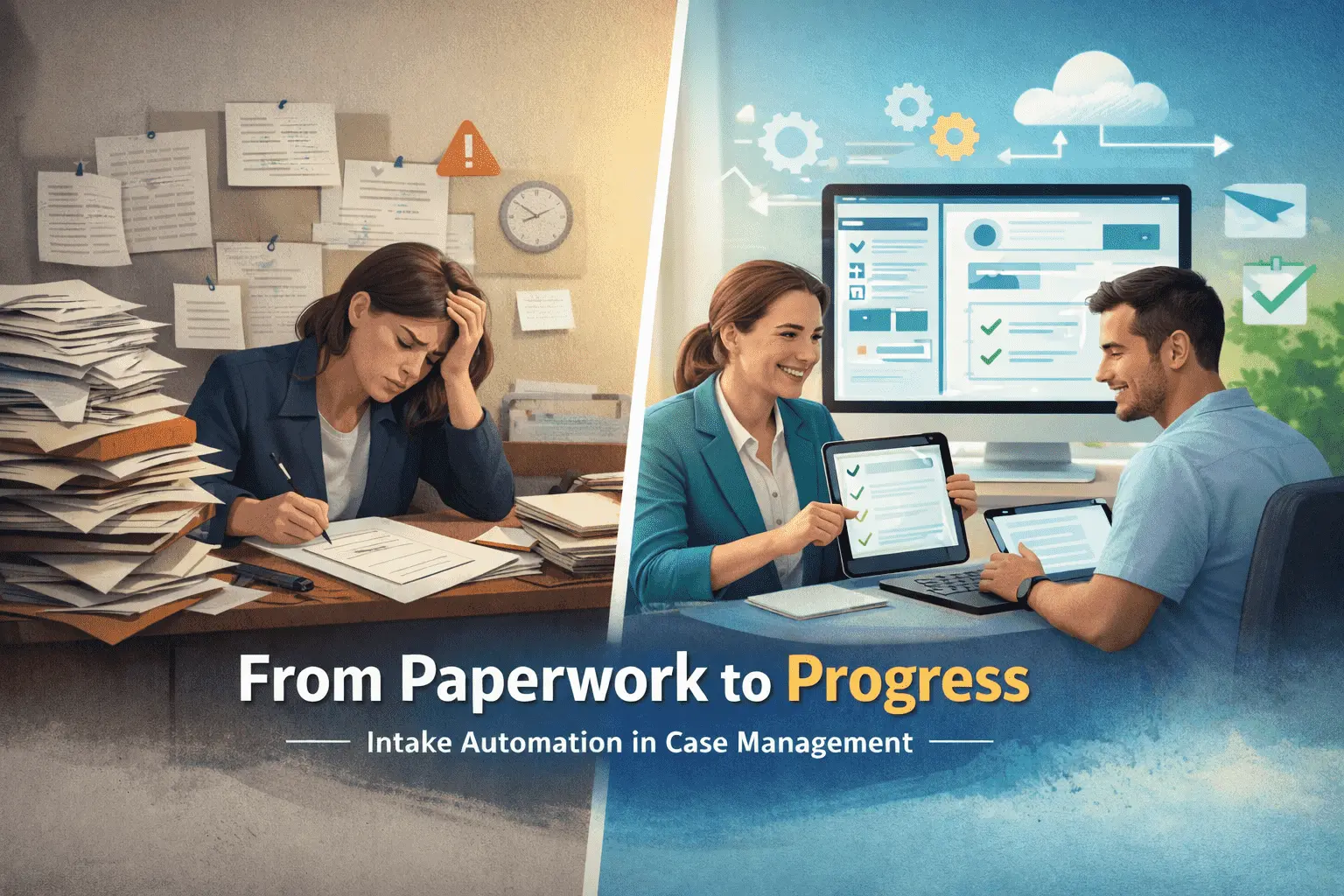
As you look to improve processes in 2026, one of the best things you can do for your team is to streamline the intake process through automation. Case management software like PlanStreet offers intake automation that helps your organization work faster with fewer errors for a less stressful workday, allowing them to focus on what they love to do: help clients thrive.
Manual Intake vs Automated Intake for Case Management: Common Challenges
While manual intake was the status quo for decades, it comes at a high price. It costs the average American business $28,500 per employee per year. This shows how much room there is for saving money when it comes to repeatable tasks. For bootstrapped government agencies and nonprofits, automating these processes can save a stressed budget.
Manual intake comes with many of the following challenges:
- Data Quality Decreases: Illegible handwriting, skipped fields, and inconsistent formats contribute to incomplete records. This can cause gaps in client eligibility and needs.
- Increase in Human Error: Re‑keying data from paper into systems causes typos and omissions, which can lead to high claim denial rates and rejected insurance submissions.
- Lost Information: A paper form can be filed in the wrong place or accidentally thrown away. This can create duplicate work and make it harder to see the entire picture of a client's needs.
- Compliance Risk: Manual record‑keeping complicates compliance, since physical forms are vulnerable to loss, unauthorized access, or disasters.
- Time-Consuming Processes: Manual data entry creates front‑desk bottlenecks, lengthening the time before a client can be seen and helped. Plus, a staff member may have to follow up to correct mistakes or gather missing information.
With all of these complications, it's time to shift processes to help your team complete intake faster.
Why Your Team Needs Intake Automation for Case Management
Automated intake for case management creates a digital resource for client forms stored in your software. This allows team members to fully collect all of the information needed, and it attaches to their case file, making the information accessible any time, anywhere.
Here's an overview of how intake automation works:
- Your team uses a document builder to create digital intake forms for case management. Many care management software platforms have pre-built templates to meet specific use cases, such as Medicaid.
- Your clients fill out forms online. By using data validation and conditional logic, clients always fill out all the required fields. In turn, they're only answering questions relevant to their case.
- Automated client onboarding creates a record instantly. As soon as a client fills out a form, the data is immediately captured and populated in their profile—no more manual data entry. Plus, any errors are flagged for immediate attention.
- Completed paperwork triggers workflows. Your team can set up task sequences based on when a client completes their intake, so no one is left waiting on the go-ahead from a team member to start work.
- Data can be used across case management features. The information you collected during intake can now be utilized to speed up scheduling, referrals, and reporting.
Intake automation for case management replaces paper forms and manual data entry with digital workflows that capture client information once. Then, it routes and reuses the data throughout your system.
4 Key Benefits of Intake Automation for Social Services
Social services organizations have the tricky task of doing the most work possible to help clients while sticking to budgets dependent upon donations, grants, and other forms of government funding. Intake automation is the first step of improving workflows to maximize every day, helping your staff who are juggling both administrative and client-facing tasks to avoid burnout.
1. Increased Efficiency
A social worker in any field needs time to strategize about the best solutions for their clients. That's probably why 65% of knowledge workers feel less stressed when automating repetitive, manual tasks. Case managers, social workers, therapists, and more can spend their time crafting case plans, communicating with family members, and scheduling services, rather than doing paperwork. This makes them more efficient with the precious eight hours per day they're given.
2. Improved Data Accuracy
50% of organizations believe that automation reduces or eliminates human error. It can help your team flag errors before they become a problem. Say that a team member tries to create a second case file for a client who already has one. Your case management software can alert that one was already created, and then any necessary notes can be added there. This prevents complications like dual data entry or spreadsheet version confusion.
3. Enhanced Client Satisfaction
Digital client intake forms mean that they can be completed from any location. Your client can fill out the form before they ever set foot in your office. They don't have to wait in long lines or fill out a form twice because the first one went missing. This creates a faster process for your clients, improving their experience working with your agency.
4. Regulatory Compliance
Intake process automation helps nonprofits stay compliant by standardizing how data is collected, stored, and reported. Plus, it keeps a record of every action through an automatic log, which is critical if audited. This reduces the risk of missing documentation or records, which could trigger penalties or worse, loss of funding.
Intake automation can help your organization remain compliant with:
- HIPAA
- Government programs like HUD and Medicaid
- Additional state and county requirements
Intake automation platforms are often paired with robust data analytics. These utilize data collected during intake and help you create easy-to-read reports to share with funders and other stakeholders, showing your compliance.
How Different Sectors Benefit from Client Intake Automation
While client intake workflow automation benefits many sectors, the emphasis hits differently on each one. For healthcare, safety and insurance reimbursement are two valuable factors, while in social services, it allows for quicker services coordination. Across all of them, the main gains are improved data, fewer hours spent on manual work, and a better experience for clients.
Intake Automation for Healthcare Providers
For healthcare providers, automated intake allows patients to quickly provide their information, reducing wait times and ensuring compliance with health data regulations. It captures all the critical information needed in a structured form, including:
- Demographics
- Insurance
- Consents
- Clinical screening data
When this information is captured correctly, it reduces intake times and improves billing accuracy. The more accurate the billing, the less time hospital administration worries about claim denials.
A common concern for healthcare providers is how intake automation software integrates with their existing systems, especially when working with an electronic health record (EHR). Modern intake software typically works seamlessly with case management software, so it's a built-in solution. Plus, software like PlanStreet can use open APIs to connect to an enterprise system, allowing teams to hold on to the legacy software they know so well.
Intake Automation for Nonprofits and Government Agencies
Nonprofits and government agencies deal with a large volume of cases, and have to find the bandwidth to help as many people as possible. With client intake, they can scale their operations without adding extra administrative costs, efficiently managing the intake of new clients and services.
And that's exactly what Equal Hope did when they implemented PlanStreet's case management software. Equal Hope is a nonprofit organization dedicated to eliminating health disparities and improving health outcomes for women. However, they struggled with fragmented data between outreach, clinical partners, and patient navigation teams. They needed a single place to collect and store information so that all relevant parties could review it.
Once they implemented a customized platform from Planstreet, they achieved:
- Seamless Client Intake: An automated digital intake process captures patient demographics, screening eligibility, and medical history, reducing paperwork and errors.
- Coordinated Care Navigation: Automated task assignments and referral workflows ensure every patient receives timely follow-up for screenings, diagnostics, and treatment.
- Outreach and Program Tracking: PlanStreet's built-in outreach management tools allow Equal Hope to monitor community engagement and screening events in real time.
Sometimes, nonprofit and government agencies avoid using new software because of the implementation cost. However, PlanStreet offers an affordable monthly fee that offers long-term savings from improved efficiency and reduced errors.
PlanStreet's Intake Automation: a Must-Have Feature for Case Management Software in 2026
As we move into 2026, organizations must modernize their processes to remain competitive and deliver timely, high-quality services to clients. PlanStreet can help you future-proof your case management with time-saving features like intake automation, a self-serving client portal, customizable workflows, and so much more.
PlanStreet's automated features set the foundation for future growth, allowing your organizations to scale properly as the needs of your clients and community increase—without adding more staff.
Ready to streamline your intake process? Schedule a demo today and see how PlanStreet can meet your agency's evolving needs.